
Ashlesha Nakshatra
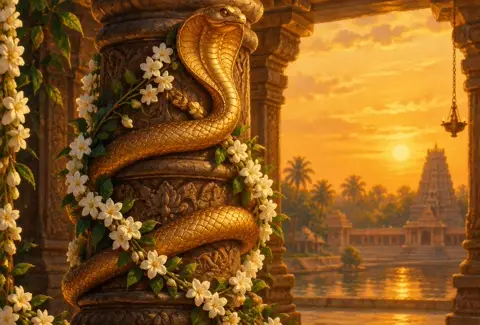
Ashlesha nakshatra, the 9th of the 27, covers the last 13°20′ of Kark (Cancer), from 16°40′ to 30°00′. Ashlesha means the embrace or the entwiner, and its symbol is a coiled serpent. The Nagas, the serpent deities, preside over it and Mercury is its lord.
Lord
Mercury
Deity
the Nagas, serpent deities
Symbol
a coiled serpent
Gana
Rakshasa
Nadi
Antya
Letters
Di, Du, De, Do
Ashlesha nakshatra padas
| Pada | Starts at | Letter | Rashi | Navamsa |
|---|---|---|---|---|
| 1 | 16°40′ Cancer | Di | Cancer (Kark) | Sagittarius |
| 2 | 20°00′ Cancer | Du | Cancer (Kark) | Capricorn |
| 3 | 23°20′ Cancer | De | Cancer (Kark) | Aquarius |
| 4 | 26°40′ Cancer | Do | Cancer (Kark) | Pisces |
Ashlesha nakshatra meaning and deity
The Nagas are the serpent beings of the underworld and the waters, keepers of treasure and of hidden knowledge, at once feared and worshipped. Ashlesha carries their gifts: penetrating insight, a hold that does not let go, and a talent for working below the surface. The serpent coiled in an embrace is its symbol.
In the Ramayana Lakshmana and Shatrughna are born under Ashlesha, the brothers known for unshakeable loyalty, which shows the protective side of the serpent star. Mercury as lord adds intellect and persuasion. Ashlesha ends at the last degree of Kark, a water sign, where Magha begins Simha, a fire sign: one of the three gandanta junctions, and the reason Ashlesha is a gandmool star.
The four padas of Ashlesha
Pada 1 (letter Di, 16°40′ to 20°00′ Kark) takes Dhanu as its navamsa, ruled by Jupiter, the most principled and generous quarter. Pada 2 (letter Du, 20°00′ to 23°20′) and pada 3 (letter De, 23°20′ to 26°40′) both answer to Saturn in the navamsa, as Makar and Kumbh, the most guarded and ambitious quarters, suited to business, politics and strategy.
Pada 4 (letter Do, 26°40′ to 30°00′) has a Meen navamsa, so Jupiter colours it and lies at the gandanta itself, so it is the pada most often marked for shanti. Names such as Dinesh or Divya for Di, Durgesh or Dulari for Du, Dev or Devika for De and Dolly for Do follow the custom.
Ashlesha nakshatra characteristics
Ashlesha natives are perceptive, strategic, private and persuasive. They read people quickly, remember everything and can hold on to a goal, or a grudge, for years. Classical verses are severe about the star, warning of cunning and ingratitude; read today, the same lines describe a shrewd mind that needs ethical commitments to point it the right way. Psychology, medicine, pharmacy, politics, negotiation, research and the occult suit the star.
Kark's water makes them emotionally deep and protective of family, and rakshasa gana adds self-reliance. The cat yoni describes independence and watchfulness. Ashlesha natives trust slowly and test loyalty, but once committed they are fiercely protective, as Lakshmana was.
Ashlesha in kundli matching (kundli milan)
Ashlesha is rakshasa gana with the cat yoni on the Antya nadi. Punarvasu is its fellow cat, and the rat stars of Simha, Magha and Purva Phalguni, are its enemies, a pairing that tradition reads literally. Krittika and Rohini are among the stars that share its nadi.
Ashlesha's list is headed by two rakshasa stars outside its nadi, Jyeshtha and Mula, at 19 of 21; Chitra, Dhanishta and Shatabhisha come next at 17½. Rohini and Uttara Ashadha stop at 3½, and Magha, its neighbour across the Kark-Simha border, does poorly too, losing yoni and nadi.
Each star's koota points with Ashlesha
| Partner nakshatra | Tara (3) | Yoni (4) | Gana (6) | Nadi (8) | Of 21 |
|---|---|---|---|---|---|
| Ashwini | 3 | 2 | 1 | 8 | 14 |
| Bharani | 1½ | 2 | 0 | 8 | 11½ |
| Krittika | 1½ | 2 | 6 | 0 | 9½ |
| Rohini | 1½ | 2 | 0 | 0 | 3½ |
| Mrigashira | 1½ | 2 | 1 | 8 | 12½ |
| Ardra | 1½ | 2 | 0 | 8 | 11½ |
| Punarvasu | 1½ | 4 | 1 | 8 | 14½ |
| Pushya | 3 | 2 | 1 | 8 | 14 |
| Magha | 3 | 0 | 6 | 0 | 9 |
| Purva Phalguni | 1½ | 0 | 0 | 8 | 9½ |
| Uttara Phalguni | 1½ | 2 | 0 | 8 | 11½ |
| Hasta | 1½ | 2 | 1 | 8 | 12½ |
| Chitra | 1½ | 2 | 6 | 8 | 17½ |
| Swati | 1½ | 2 | 1 | 0 | 4½ |
| Vishakha | 1½ | 2 | 6 | 0 | 9½ |
| Anuradha | 3 | 2 | 1 | 8 | 14 |
| Jyeshtha | 3 | 2 | 6 | 8 | 19 |
| Mula | 3 | 2 | 6 | 8 | 19 |
| Purva Ashadha | 1½ | 2 | 0 | 8 | 11½ |
| Uttara Ashadha | 1½ | 2 | 0 | 0 | 3½ |
| Shravana | 1½ | 2 | 1 | 0 | 4½ |
| Dhanishta | 1½ | 2 | 6 | 8 | 17½ |
| Shatabhisha | 1½ | 2 | 6 | 8 | 17½ |
| Purva Bhadrapada | 1½ | 2 | 0 | 8 | 11½ |
| Uttara Bhadrapada | 3 | 2 | 0 | 8 | 13 |
| Revati | 3 | 2 | 1 | 0 | 6 |
Ashlesha in muhurat and gandmool
Muhurta Chintamani lists Ashlesha among the tikshna, sharp, stars, used for firm actions, confrontation and severing ties rather than celebrations; it is on neither the vivah nor the griha pravesh list. A birth in Ashlesha is gandmool and families usually perform the gandmool shanti on the 27th day. Nag Panchami, the main serpent festival, is fixed by its tithi, Shravana Shukla Panchami, rather than by this star, though both honour the nagas. In Kerala the star is called Ayilyam, and the Ayilyam days of Thulam and Kanni draw large crowds to the serpent shrine at Mannarasala, where offerings are made for the welfare of children.
Ashlesha remedies and worship
Serpent worship is the traditional practice: offering milk at a naga shrine or anthill, keeping Nag Panchami, and honouring Shiva, who wears the serpent. The Sun passes through Ashlesha from about 2 to 16 August, deep in the monsoon, the season in which Nag Panchami often falls. Because Mercury rules the star, Wednesday observances and the Vishnu Sahasranama are also common.
Ashlesha and the Vimshottari dasha
An Ashlesha birth begins in Mercury mahadasha, 17 years in full. The Moon's position in the star decides the balance: early in Ashlesha leaves nearly all of it, late in Ashlesha very little. Ketu's 7 years follow and then Venus's 20.
Ashlesha and respectful privacy within close families
In a close household, affection often arrives as questions: who called, what happened at work, why is the bedroom door shut? Someone connected with Ashlesha may recognise the tenderness behind these questions while still wanting private space. The family task is to protect closeness without requiring every thought, message, or friendship to become common property.
Ashlesha's serpent symbolism offers an image of a protected inner place. The Nagas belong to sacred stories of hidden treasures and guarded waters. At home, this can inspire respect for what another person holds carefully: a diary, an unfinished ambition, or a confidence shared by a friend. Trust becomes stronger when curiosity learns where to stop.
Mercury's association adds a useful emphasis on language. Asking whether somebody wants advice can be kinder than immediately offering it. Ashlesha conversations become clearer when requests are direct, especially around borrowed belongings, shared rooms, and photographs posted in family groups. A boundary explained with affection need not sound like withdrawal.
Ashlesha traditional reference
| Association | Traditional detail |
|---|---|
| Deities | The Nagas |
| Planetary ruler | Mercury |
| Emblem | Coiled serpent |
| Rashi | Kark |
Agree on what stays personal
Begin with ordinary examples, such as knocking before entering or asking before forwarding a picture. Ashlesha privacy feels less mysterious when the household understands the same everyday courtesies.
Separate confidence from family news
Before repeating something sensitive, check whether the speaker intended it to travel. Even a proud announcement about a new job may belong first to the person whose life is changing.
Offer support without an interrogation
An invitation to sit together can communicate care without demanding disclosure. Leave the door open for a later conversation, and continue including the person in meals and small household pleasures.
Notice trust being returned
When someone volunteers a worry, receive it calmly rather than rewarding openness with more questions. Ashlesha's protective embrace can then become spacious: a place where family members feel held and still remain themselves.
Frequently asked questions
Is Ashlesha nakshatra a gandmool nakshatra?
Yes. Ashlesha's last degree is also Kark's last degree, where the water signs end and Simha's fire begins, and births near such a junction are called gandmool. Many families mark the Moon's first return to Ashlesha, a lunar month later, with a shanti puja and a blessing for the parents.
Who was born in Ashlesha nakshatra?
In Valmiki's Ramayana Lakshmana and Shatrughna are born under Ashlesha, the star of the serpents. Lakshmana is also traditionally seen as an incarnation of Shesha, the serpent on whom Vishnu rests.
Who pairs best with an Ashlesha Moon?
Jyeshtha and Mula, both rakshasa stars outside Ashlesha's Antya nadi, reach 19 of the 21 star points. At the other end Rohini and Uttara Ashadha share Ashlesha's nadi and stop at 3½, and Magha and Purva Phalguni, the rat stars, clash with Ashlesha's cat yoni.
Which syllables are used for Ashlesha names?
Di, Du, De and Do take the D series through the last 13°20′ of Kark. Do, the fourth, sits on the gandanta with Simha and is the pada most often marked for shanti.
What does Ashlesha mean?
Ashlesha means the embrace or the entwiner, pictured as a coiled serpent. The Nagas preside over the star, so it is linked with hidden knowledge, persuasion and a firm hold.
Which rashi is Ashlesha nakshatra?
All of Ashlesha lies in Kark (Cancer), from 16°40′ to 30°00′, so an Ashlesha Moon is a Kark Moon. Its last pada touches the Kark-Simha border, the gandanta point, and the next star, Magha, opens Simha.
From lagna to the running dasha, one written report covers your own chart.
Get my kundli report, ₹149