
Uttara Ashadha Nakshatra
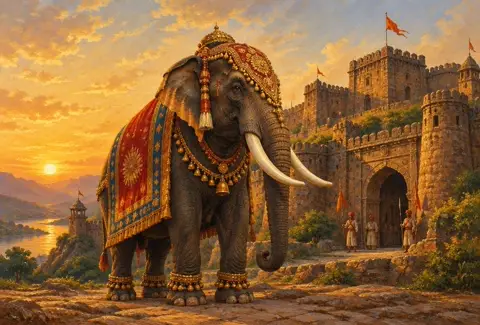
Uttara Ashadha nakshatra, the 21st of the 27, runs from 26°40′ of Dhanu (Sagittarius) to 10°00′ of Makar (Capricorn): one pada in Sagittarius and three in Capricorn. Its name means the latter invincible one, and its symbol is an elephant's tusk or the planks of a bed. The Vishvadevas, the universal gods, preside over it and the Sun is its lord.
Lord
Sun
Deity
the Vishvedevas, universal gods
Symbol
an elephant's tusk
Gana
Manushya
Nadi
Antya
Letters
Be, Bo, Ja, Ji
Uttara Ashadha nakshatra padas
| Pada | Starts at | Letter | Rashi | Navamsa |
|---|---|---|---|---|
| 1 | 26°40′ Sagittarius | Be | Sagittarius (Dhanu) | Sagittarius |
| 2 | 0°00′ Capricorn | Bo | Capricorn (Makar) | Capricorn |
| 3 | 3°20′ Capricorn | Ja | Capricorn (Makar) | Aquarius |
| 4 | 6°40′ Capricorn | Ji | Capricorn (Makar) | Pisces |
Uttara Ashadha nakshatra meaning and deity
The Vishvadevas are the gods of all, a group of ten deities honoured together in the Vedic rites and in shraddha, standing for goodness that belongs to everyone. Uttara Ashadha takes from them a sense of universal duty: lasting victory won fairly, for the good of all. The elephant's tusk is strength used with restraint. The Puranas name the ten Vishvadevas as Vasu, Satya, Kratu, Daksha, Kala, Kama, Dhriti, Kuru, Pururavas and Madravas, gods of truth, time, desire and steadfastness.
The Sun as lord adds integrity and leadership, and the move from Jupiter's Dhanu into Saturn's Makar joins principle to discipline. The Sun crosses Uttara Ashadha from about 11 to 24 January, so Makar Sankranti, the Sun's entry into Makar, falls in this star, and with it Lohri, Pongal and the kite-flying of Uttarayan. The traditional calendar counts Uttarayana, the Sun's northward half of the year, from that day. The last pada of Uttara Ashadha also forms the first part of Abhijit, the short extra star used in muhurat, which runs to about 10°53′ Makar. In Kerala the star is Uthradam, and Uthradam in Chingam, the eve of Thiruvonam, is the first Onam, the day of shopping and preparation before the festival.
Uttara Ashadha pada by pada
Pada 1 (letter Be, 26°40′ to 30°00′ Dhanu) is Dhanu navamsa in Dhanu rashi, vargottama, the most principled and generous quarter. Pada 2 (letter Bo, 0°00′ to 3°20′ Makar) is Makar navamsa in Makar rashi, also vargottama, the most disciplined and ambitious.
Pada 3 (letter Ja, 3°20′ to 6°40′ Makar) has a Kumbh navamsa, so Saturn colours it, the most humanitarian. Pada 4 (letter Ji, 6°40′ to 10°00′) maps to Meen in the navamsa, under Jupiter and lies inside Abhijit, the most devout and compassionate. Names such as Bela or Beni for Be, Bodhi or Bodhan for Bo, Jagat or Jaya for Ja and Jigar or Jinal for Ji follow the custom.
Uttara Ashadha nakshatra characteristics
Varahamihira describes the Uttara Ashadha native as humble, righteous, with many friends, grateful and fortunate. The star gives integrity, responsibility and staying power: judges, administrators, officers, leaders of institutions and long-term planners are typical. Uttara Ashadha natives win slowly but their victories last.
The difficulty is rigidity and a heavy sense of duty that leaves little room for rest. Manushya gana gives a sociable temperament, and the mongoose yoni, which no other nakshatra shares, a lone, alert and determined character.
Uttara Ashadha in kundli matching (kundli milan)
Uttara Ashadha is manushya gana on the Antya nadi with the mongoose yoni, which no other star shares, so it never takes the full 4 yoni points. The serpent stars Rohini and Mrigashira are the mongoose's enemies. Shravana, the next star, sits on the same nadi.
Four stars share Uttara Ashadha's best mark of 19 of 21: Bharani, Purva Phalguni, Uttara Phalguni and Purva Ashadha, the star just before it. Hasta reaches 18. Shravana, the star after it, falls to 10 on the shared nadi, and Ashlesha, Magha and Vishakha are lowest at 3½.
Each star's koota points with Uttara Ashadha
| Partner nakshatra | Tara (3) | Yoni (4) | Gana (6) | Nadi (8) | Of 21 |
|---|---|---|---|---|---|
| Ashwini | 1½ | 2 | 5 | 8 | 16½ |
| Bharani | 3 | 2 | 6 | 8 | 19 |
| Krittika | 3 | 2 | 0 | 0 | 5 |
| Rohini | 3 | 0 | 6 | 0 | 9 |
| Mrigashira | 1½ | 0 | 5 | 8 | 14½ |
| Ardra | 1½ | 2 | 6 | 8 | 17½ |
| Punarvasu | 1½ | 2 | 5 | 8 | 16½ |
| Pushya | 1½ | 2 | 5 | 8 | 16½ |
| Ashlesha | 1½ | 2 | 0 | 0 | 3½ |
| Magha | 1½ | 2 | 0 | 0 | 3½ |
| Purva Phalguni | 3 | 2 | 6 | 8 | 19 |
| Uttara Phalguni | 3 | 2 | 6 | 8 | 19 |
| Hasta | 3 | 2 | 5 | 8 | 18 |
| Chitra | 1½ | 2 | 0 | 8 | 11½ |
| Swati | 1½ | 2 | 5 | 0 | 8½ |
| Vishakha | 1½ | 2 | 0 | 0 | 3½ |
| Anuradha | 1½ | 2 | 5 | 8 | 16½ |
| Jyeshtha | 1½ | 2 | 0 | 8 | 11½ |
| Mula | 1½ | 2 | 0 | 8 | 11½ |
| Purva Ashadha | 3 | 2 | 6 | 8 | 19 |
| Shravana | 3 | 2 | 5 | 0 | 10 |
| Dhanishta | 1½ | 2 | 0 | 8 | 11½ |
| Shatabhisha | 1½ | 2 | 0 | 8 | 11½ |
| Purva Bhadrapada | 1½ | 2 | 6 | 8 | 17½ |
| Uttara Bhadrapada | 1½ | 2 | 6 | 8 | 17½ |
| Revati | 1½ | 2 | 5 | 0 | 8½ |
Uttara Ashadha in muhurat
Muhurta Chintamani counts Uttara Ashadha among the dhruva, fixed, stars with Rohini and the other two Uttaras, good for foundations and lasting undertakings, and it is on both the vivah and griha pravesh lists. In the Navratri Saraswati sequence, the offering to the goddess is made when the Moon is in Uttara Ashadha.
Uttara Ashadha remedies and worship
Surya worship at sunrise and the Aditya Hridayam honour the Sun, and Ganesha, whose tusk is the star's symbol, is worshipped before new undertakings. Feeding guests and giving during Makar Sankranti suit the star of the universal gods.
Uttara Ashadha and the Vimshottari dasha
An Uttara Ashadha birth begins in the Sun's mahadasha, 6 years in full, followed by the Moon's 10 and Mars's 7. A Moon in the Makar padas leaves only part of the Sun's short period: at 3°20′ Makar, the middle of the star, 3 years remain. Its main stars are usually identified as Nunki and Ascella, σ and ζ Sagittarii, in the handle of the Teapot asterism.
Uttara Ashadha and passing on a family enterprise fairly
A small family business may hold decades of effort alongside difficult questions about who will lead next. Uttara Ashadha offers a constructive theme for this transition: lasting achievement deserves a process that people can understand, including relatives whose work has rarely appeared on a visiting card.
The Vishvedevas, the universal gods, preside over Uttara Ashadha. Its traditional emphasis on principles can be brought into the ordinary details of succession: responsibilities, training, decision making and recognition. The elephant’s tusk symbol gives a fitting image of something substantial that must be handled thoughtfully rather than passed around casually.
Begin by separating affection from job descriptions. A daughter who lives elsewhere may still contribute valuable expertise; a nephew working daily may need clearer authority. Uttara Ashadha’s steadiness can help elders hear these realities without treating every proposed change as criticism of the enterprise they built.
Traditional reference points
| Attribute | Association |
|---|---|
| Deity | The Vishvedevas |
| Planetary lord | Sun |
| Symbol | An elephant’s tusk |
| Nature | Fixed |
Put the working roles on paper
List who handles customers, accounts, suppliers and staff questions. Invite each person to correct the description. Agreement about present work makes discussion of future leadership more concrete and less personal.
Recognise effort that stays unseen
Family members may have provided meals, childcare or unpaid administration while others ran the shop. Acknowledging this contribution helps the household remember that an enterprise can depend on support beyond its counter.
Arrange a gradual transfer of responsibility
Let the incoming person manage one defined area before taking broader charge. Set review meetings where the elder can explain past decisions and the successor can describe what current conditions require.
Preserve the founding value, not every habit
Ask the founder which promise to customers matters most, then discuss new ways of keeping it. Uttara Ashadha’s enduring quality need not mean repeating every old procedure. A written understanding and respectful conversation can make continuity feel generous, giving the older generation visible honour and the younger generation a genuine opportunity to serve well.
Frequently asked questions
Is Uttara Ashadha good for marriage?
Yes. As one of the fixed Uttaras, Uttara Ashadha is valued for a bond meant to last, and both wedding and griha pravesh tables include it; its Sun rulership is read as a blessing of steadiness.
Which rashi is Uttara Ashadha?
One pada lies in Dhanu (Sagittarius) and three in Makar (Capricorn). The Dhanu pada and the first Makar pada are vargottama, each repeating its own sign in the navamsa.
What is the link between Uttara Ashadha and Abhijit?
Abhijit, the short extra star used in muhurat, runs from 6°40′ to about 10°53′ Makar, covering Uttara Ashadha's fourth pada and the start of Shravana. The 27-star system folds it into those two.
Which nakshatra matches best with Uttara Ashadha?
Four stars share first place at 19: Bharani, Purva Phalguni, Uttara Phalguni and Purva Ashadha. Hasta reaches 18. Ashlesha, Magha and Vishakha, all on the Antya nadi with Uttara Ashadha, reach 3½.
Which syllables begin Uttara Ashadha names?
Be in Dhanu, then Bo, Ja and Ji in Makar. Ji names belong to the pada that also forms the first part of Abhijit.
Why is Uttara Ashadha's yoni unique?
Uttara Ashadha is the only nakshatra with the mongoose yoni, so no other star gives it the full 4 yoni points. Its yoni enemies are the serpent stars, Rohini and Mrigashira.
Want the meaning behind your lagna and Moon sign? The report writes it out from your birth details.
Get my kundli report, ₹149